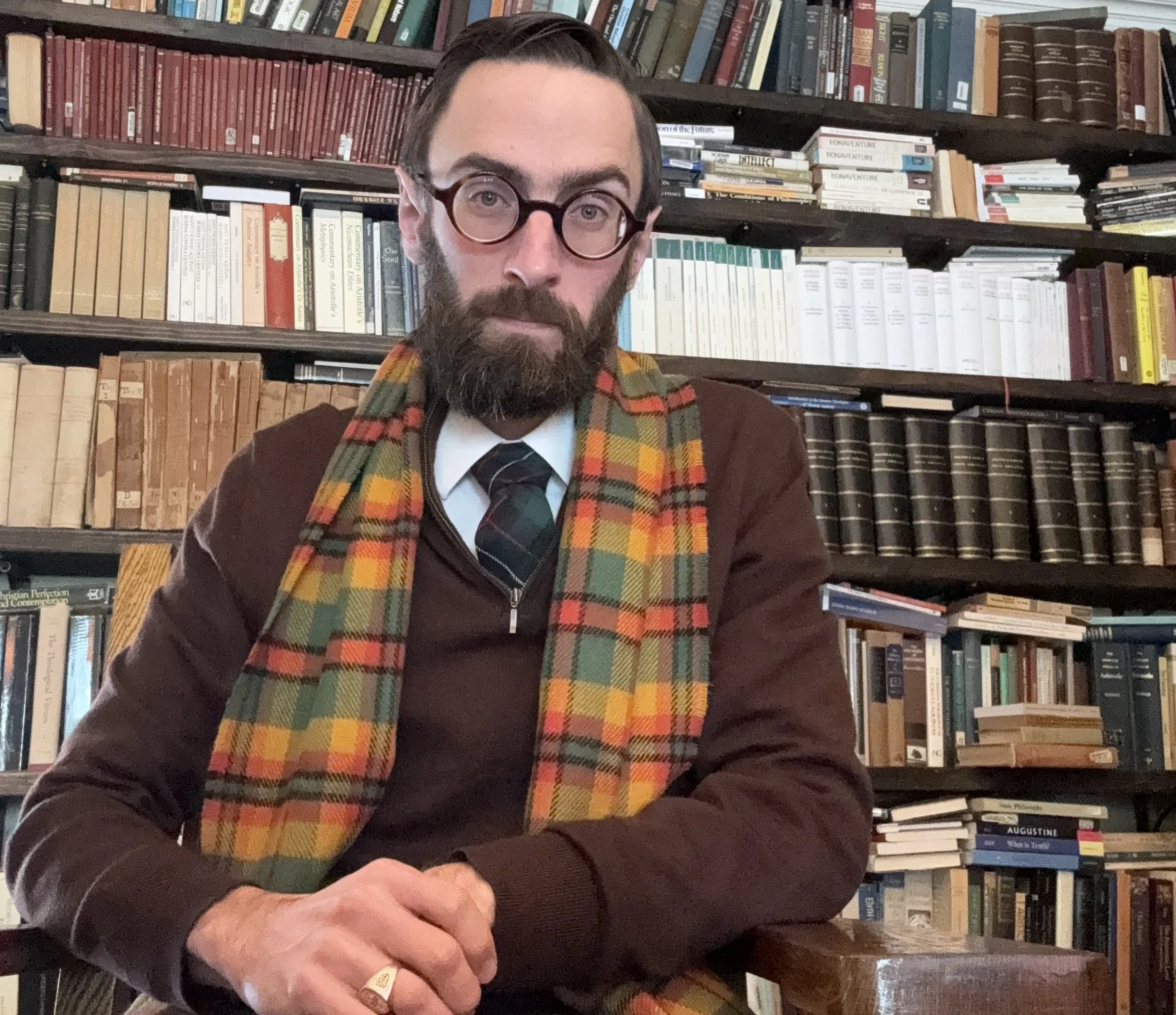
“The Existence of an Ultimate End for Human Life” (Marie Albert Janvier, O.P.)
Translation Introduction
The present translation represents part of a long, albeit occasional, series of texts I will post to To Be a Thomist as a recovery of the multi-year (over twenty years!) cycle of Lenten sermons delivered by Marie Albert Janvier, O.P. at Notre-Dame de Paris, gradually working through the treatises of the Summa theologiae’s Secunda pars. I am presenting these texts for a variety of reasons: because I myself want to more closely meditate on them; they are worthy in their own right; they provide a model for preaching sorely needed; and they put the lie to the narrative that we had to wait until the mid-20th century to have a renewed Catholic moral theology.1
Summary
Jesus Christ, the necessary Doctor of dogmatic and moral truth.—The Church, the sole interpreter of the doctrine of Jesus Christ.—The rights of reason with regard to Catholic truth.—The role of the holy Fathers of the Church and holy Doctors in the defense of this truth.—The illuminative power of St. Thomas Aquinas.—Assistance drawn from contemporary science. The problem of morality, one of the most agitated and burning questions of our era.—The question of the last end, the fundamental question of morality.—The first conference that logic imposes upon us.—The existence of a last end for human life.—[Janvier’s] homage to His Excellency Msgr. Lorenzelli, apostolic nuncio, and to Fr. Étourneau, his predecessor in the pulpit of Notre-Dame.
I
Definition of beatitude and of the last end; their names.—The existence of this supreme end affirmed by Holy Scripture and by faith.—Rational demonstration: a) Every being moves in order to attain an end and to acquire a good. b) The reason for this movement: the ontological poverty of finite beings, especially bodily ones.—Man is subject to this law. c) To emerge from its indifference, the being in question must be moved by its own good, real or apparent.— Various systems and various admissions concerning final causes. d) Man’s freedom does not exempt him from the dominion of the good. Even when he wills evil, he seeks a good. e) What is more, man acts in view of the good and of the end even more than do other earthly beings, for he knows the intelligible character (ratio) of the good and of the end and the relation of means to end.
II
1. The law of finality rests on the reality of a supreme good and a last end. a) A regression to infinity is impossible in the series of goods and ends that are subordinated in their action. b) The suppression of the last end entails the suppression of every secondary end, every good, every moral action, and indeed all movement. c) Consequently, the wisdom and good sense that require us to confess the existence of goods and ends, of moral operations and changes, likewise require us to recognize a sovereign good and a supreme end.
2. This argument proves not merely the necessity of an apparent last end, but the necessity of a real last end. If the passing shadows of partial goods can stir our soul, they nonetheless cannot satisfy it. The object of the will is being, not its representation.
3. a) The desire for the perfect good is a real desire that we find everywhere, always, in all men—consequently, a natural desire. b) The reality of this desire entails the reality of the object corresponding to it, for God and nature do nothing in vain. All the sciences practically recognize the truth of this principle, namely that to a faculty, to an organ, there corresponds an object.
a) Happiness exists: faith and philosophy teach us this with certitude. b) This certitude is the condemnation of pessimism. c) There is a fixed morality and a duty, both of which rest upon man’s true last end.
The Existence of an Ultimate End for Human Life
Your Excellency [Archbishop Benedetto Lorenzelli, apostolic nuncio],
Monseigneur [Henri-Victor Altmayer, O.P., former Archbishop of Baghdad]²
Gentlemen,
There is but one, necessary doctor of humanity: Jesus Christ. He teaches us how to think and how to live. The sum of all truth and goodness that must exist in the world depends on our docility in listening to His voice and in our readiness to follow His words.
As soon as the mind cuts itself free from the Gospel, yes, it founders upon the very threshold of the mysteries of God. But, beyond that, as though it were abandoned by its own light, it allows itself to be lost and bewildered even within its own domain, blaspheming what it does not know and corrupting what it does know.
And, as soon as the will breaks free from the law of Jesus Christ, it collapses beneath the weight of the appetites. In the blink of an eye, with great ease, man becomes a pagan anew—false, egoistic, voluptuous, ferocious, or even all of these together.
This is why the saviors of truth and of morality will always be—first and foremost—the apostles who teach us to believe and practice the lessons of the Son of God.
But the Gospel will not accomplish its work of illumination and sanctification unless it retains the eternal sense that its Author gave it. Now, sincerity and good will notwithstanding, if Revelation were abandoned to the genius and interpretation uttered by each individual, we know the obvious outcome: as many Christs and as many Gospels as there are individuals—nay, shadows of Gospels, phantoms of Christs.
Therefore, by an absolute will of God, the Church is the sole and only school of Jesus. In her bosom—yes, in her bosom alone—we find the authentic and complete idea of the Master. Consequently, should you like to affirm the doctrine of Jesus Christ? Then, there is but one option: you must teach the infallible interpretation that the Church gives of it in her Councils and through her Sacred Pontiffs.
And yet, when reason considers the Church, Jesus Christ, and even God Himself, it retains one right: the right to prove to the lights of reason itself that it is obliged to adhere to this Revelation because this Revelation—far from contradicting wisdom—in fact bears the evidence of its supernatural origin. This is the work of the apologist: to make this evidence shine forth before the eyes of his hearers.
If the apologist were to seek in himself alone the light capable of efficaciously exalting Catholic truth, he would run the risk of compromising it. But God has spared us this worry and this danger. He has created2 masters of the intellect destined to clothe in splendor the heights of faith and morals. There is not a dogma that does not have its doctor among the holy Fathers of the Church, nor any great error that does not find an invincible adversary among one or another of their august ranks. Against Antoninus, Marcus Aurelius, or Commodus—indeed against all persecutors who might yet come through the years of history—Justin and Athenagoras will forever prove religion’s right to freedom. The weapons of Irenaeus, victorious over Valentinus and Marcion, will forever strike to the very heart all new gnostics who would save one half of the world—the “simple”—by faith, and the other half—the “great”—by science. Cyprian, who died in the third century, will teach Bossuet in the seventeenth to defend the unity of the Church and will help the [First] Vatican Council proclaim the primacy of Peter. From Celsus or Arius down to Strauss and to Renan, all who blaspheme the Trinity of Divine Persons and the Divinity of Christ will be laid low by the arguments arrayed on the quill of Athanasius. All who detract from human freedom—from Mani to Luther and Calvin, from Cornelius Jansen to Littré, Comte, or Haeckel—and all who flatter human freedom—from Pelagius to Rousseau—will be confounded in the rays of that unmatched sun: St. Augustine.
Then, amid the Christian centuries, the Church brings forth a master who, for having profoundly venerated the doctors of the past, inherited, so to speak, the intelligence of them all.3 St. Thomas Aquinas descends deeper, climbs higher, and reaches farther than we can comprehend. With him, the roots, stem, and branches of truth hold together and are bound to God in a definitive wisdom and in a superabundance of light that definitively solders the immortal alliance of philosophy and religion.
These, Gentlemen, are the ever-fresh and ever-ancient sources, blazing hot with divine truth, where Christian reason will first turn when it wishes to re-temper its weapons.
Then, as far as possible, it will avail itself of every solid argument, from whatever quarter it may come: from present or past; from science, history, exegesis, or philosophy; from friends or enemies; from heaven, earth, or even from hell (for sometimes Satan himself is constrained to bear witness to God and to Jesus Christ). Such Christian reason will have but one concern: to bathe the Word of life in ever more abundant and more gracious light.
This path—tradition faithful to principles and open to progress—was trod by one of our own brothers, whose memory Notre-Dame has by no means forgotten, to the glorification of Catholic dogma. It is by using this proven method that I too will strive this year to resolve the fundamental problem of morality: the last end and the supreme beatitude of man.
I shall thereby unite my will to that of the glorious Pontiff who governs the Church, and whom you represent, your Excellency, with so lofty an understanding of goods and evils, with so ardent a love for the interests of the Roman Church and of Catholic France. I shall walk in that light which, through divine miracle, never wearies of shining in our sky and dispelling our darkness.
Today every question is a burning one. Minds are at once in the heat of the furnace and exasperated in their effervescence. Ideas are not worked out without torturing man’s heart. This acute activity makes our intellectual life a drama that begins on the summits of speculation and extends to the smallest details of practice.
The great questions of morality—its foundation, its unity, its absolute or relative character—are a poignant act in this drama. Men holding every sort of opinion seek to dispel its torment in their own souls and among their people. Alas! The radical difference among these systems carries the conflict from theory over into action and throws our societies into convulsions full of strife that rends us asunder.
Therefore, if I now begin this work of speaking to you about morality, I will be touching upon a live preoccupation of men of our day. And today, within that very preoccupation, I will turn our attention to the most sensitive point—to the great anxiety that none of us can escape: the question concerning the last end.
The existence of a last end for human life. This is first question that logic itself imposes on us if we are to understand moral matters. This will be the subject of this first conference.
I am astounded, Gentlemen, to find myself in this pulpit. It seems to me that all the accents of sincerity upon my lips will forever be drowned out by the power of other voices which, for seventy years, have made this temple—and the souls of the men gathered herein— tremble by a kind of divine force. I would have been rash to accept a mission that terrifies and confounds me, had I not been directly called by the benevolence and the authority of the holy Archbishop of Paris—which is to say, by God Himself.
Having now mounted these steps by God’s order, I have the right to count on him to set my breast aflame and to fill my open mouth with truth, to trust that I shall be able—by His inspiration—to repeat the words of eternal salvation that my predecessor taught you with a tongue that was majestic in resonance and filled with an eloquence that commands assent by its gravity, nobility, an sobriety, and that—with grace from on high and with your cooperation, gentlemen—I shall not let die the work that came forth from the lips of him who was blazing word in the service of God: Père Lacordaire.
I
What is man’s last end? It is that supreme good in virtue of which all our acts are accomplished. It is that supreme good which suffices of itself—by an excellence that it borrowed from no one else—to provoke their movement, a supreme good whose abundance, poured forth into our depths, brings our life to its consummation and fills to the brim the abyss of our desires. Whatever charm other goods have for us, whatever power they have over us, is drawn from this last end. If we covet them, we do so in order to attain this end.
Human languages have assigned to its possession famous names: felicity, happiness, beatitude, paradise. What names! They cannot land upon our ears without our whole being starting to vibrate. These are words that overflow with the two elements dearest to us: perfection and delight.
Does the last end exist? Or can the great tale of human life be explained without it and without its intervention? Such is the question facing us.
For Christians, the answer is categorical: there is a sovereign good whose power calls forth all our movements, a sovereign good that will bring contentment to the very depths of the soul when we succeed in the conquest thereof. Short of it, nothing suffices us. Beyond it, all the rest would be vain. In the words of Augustine: Nec infra remanendum est, nec ultra quærendum, “we must neither allow ourselves to remain short of it nor set our hearts to seek beyond it.”4
Sacred Scripture delights in setting into relief the sweetness and sublimity of this good, contrasting it with the harshness of the evils that weigh us down. The latter resemble the toil of the hired hand, the exhausting labor of the slave under a blazing sky, service in time of war, the bloodstained fight of the gladiator. But beatitude, what is it? In short: the joy of receiving our wages, the cool breeze of shade or the evening, rest and victory, the crown that awaits us at the end of the race.
The dogma of Providence, the mystery of the Incarnation, the whole course of religion, the teaching of the Church and of the Gospel, all presuppose the idea of salvation—and salvation is the motive of our acts and the ultimate plenitude of our being.
Therefore, Gentlemen, faith teaches us quite clearly about the existence and reality of a last end. It is an absolute truth which we cannot deny without thereby ceasing to be a Christian.
Therefore, we are not permitted to follow the various systems that directly or indirectly suppress this notion that we have a sovereign good. Thus, we must deny those who—from Empedocles to Democritus, from Lucretius to Darwin—tell us the world is mechanistic or is subject to endless evolutions. And so too do we turn from those who come to tell us that the world is subject to perpetual changes, metempsychoses, or the ceaseless transmigrations acclaimed by lips in schools of Pythagoras and all the way to the far reaches of India.
But, let us hasten to add: wisdom—resting upon reasons that are hard as iron and unmovable as adamant5—speaks very loudly in favor of Revelation.
First of all, Gentlemen, a principle imposes itself on anyone who examines the course of things and examines himself: namely, no one rouses himself from rest except to attain an end and acquire a good.
Beings move. In the kingdom of inanimate nature, an immense sum of light, heat, and electricity is produced each day. Living beings ceaselessly move from one place to another, from one state to another, from one transformation to another, going forth from themselves to join other beings, to grasp, embrace, and assimilate them, to soak them up as part of their own being. Or, if not going forth from themselves, they relentlessly labor upon their own substance.
Yet, no creature stirs itself as much as man. Who could tell the great host of thoughts, volitions, and imaginings that bear him along his way, or the fever of change that transports him?
All this presents us a fact that is undeniable—unless we wish to be madmen.
And why do beings not remain within themselves, in the state that is theirs, content with what they possess, retaining their current interior and exterior situation unchanged?
The answer is clear: because they do not find in themselves, nor in their present form, all that they need. They lack something. Otherwise, they would not seek. They would not thirst for change.
Therefore, what presses them to act is their poverty, and this imperfection manifests itself by signs ever more violent as we ascend the scale of creatures.
Gentlemen, you know the truth: Man is no exception. Raised by his nature, as it were, infinitely above the purely sensible world, he is nonetheless an unfinished being. The very sublimity of his substance makes his distress immense. Man resembles the prince whose needs multiply with his opulence. He is like those medieval edifices, already grandiose with their foundations, their portals, columns, naves, and arches, yet nonetheless desolate so long as the gigantic towers and audacious spires called for by their structure have not yet crowned them.
Those who, like the Stoics or Kant, tell us that the only thing that man needs is what he possesses in himself or through himself have consulted our nature but little. Scarcely have their eyes examined the impatience that forever hurls us toward new stages and new objects. With stopped ears, they have listened to the cry of misery that has burst forth, perhaps more than ever, from the breast of our contemporaries. If the figures of Manfred, René, Werther, or Faust have aroused so much sympathy in our literature and in our generation, this is because their unbridled sentiments gave voice—aloud and in a more heartrending way—to the eternal lament that already resounded on the lips of David, St. Paul, St. Augustine, or Pascal, a lament that the human soul has never ceased to repeat under its breath. It has been called the mal du siècle—the sickness of our age. No, gentlemen, it is the sickness of man in every age.
All beings are poor, and this is why they seek and bestir themselves. Man—richest in what he possesses, most wretched in what he needs to possess—seeks just as much as they do, indeed even more than they do.
What do they seek? Quite clearly, they seek what they lack: their complement and their perfection, in other words, the end that achieves the plenitude of their reality and life. Consequently, the object, the state that contains this perfection, is the cause of their movement. We call it an end, because it terminates that movement; we call it a good, because it befits the nature that moves and acts.
But if I am to come forth from my indifference, if this indifference is to become effort and initiative, will it suffice that I find myself faced with just any good, any goal whatsoever? No: the new being and new state presenting themselves to me must be adapted to my nature. They must appeal to what is special and, as it were, personal in my indigence. They must contain—or at least appear to contain—precisely what I lack. Otherwise, all beings in the world would fling themselves indiscriminately upon all good, and the world would fall into an unprecedented state of confusion.
Here, Gentlemen, creatures again trace out the path for us to follow. Never will you see them set themselves in motion toward an object that is not in harmony with—I do not say their faculties or their organs, but, rather—the very structure and demands of their substance.
The willow tree seeks far from its trunk to find the water it needs. The lamb looks upon the pasture and there sees grasses that powerfully rouse its appetite, whereas the lion looks upon this grass with indifference. Yet, the lion himself also experiences an irresistible fascination when looking upon this same lamb, which it devours, though the lamb’s own stomach would turn at the sight of its own flesh.
Therefore, it is not only by a general law that creatures are borne onward toward the good. There are particular laws that order each of them toward its own good—or, as Dante says, that direct them “to various ports across the great sea of being, borne on by the instinct it has been given.”6
These principles, Gentlemen, are certain.7 From the birth of philosophy—or, to speak more truly, wherever good sense has not foundered—they have been accepted. The wise men whose genius has illuminated the furrows upon our brow have taught that the law of finality governs all the evolutions of nature, that the activity of the whole world hangs upon the good, that all things act only if they are under its influence, that the universe would remain a chaos if final causes did not have their role to play. The so-called power of life, habit, need, and environment invoked by Lamarck, the struggle for existence and natural selection championed by Darwin, the mechanical necessity of Spinoza, Lucretius, and Democritus—all these either contain the idea of finality, or else they are merely so many and sundry names for efficient and material causes that would never come forth from their repose if the presence of a good did not stir them to action.
It is not I, Gentlemen, who say this. I speak to you as did Gassendi—a disciple of Epicurus and an empiricist—pointing out to Descartes not merely the notion but the existence of the ends that God has, as it were, set out in full view of everyone and which are discovered without much labor.8 It is the voice of Cabanis affirming that if we reason about causes, all the rules of probability compel us to recognize them as final.9 We likewise hear Cuvier pushing this law even further than our principle.10 And we hear the echo of that most ardent partisan of positive science, John Stuart Mill, teaching that there is no contradiction whatsoever between his method and final causes.11 So too Claude Bernard admitting the existence of a directing, organizing, vital idea—a series of phenomena that determine one another by associating or combining for a common final purpose.12 And, most recently, we have Monsieur Charles Richet, amid a debate with one of our most beloved poets. And it was a spectacle neither lacking in interest nor devoid of peculiarity: the servant of the muses inclined sadly and, as though he were full of regret—but ultimately inclined—toward materialism, while the partisan of experimental knowledge defended, timidly still yet already effectively, the cause of the ideal. Yes, Monsieur Richet was convinced that the theory of final causes cannot be eliminated from anatomy, zoology, or physiology, that the hypothesis of finality finds itself incessantly justified by experimental results, that nothing is explained by mechanism, that natural selection is not sufficient, that the law of finality has never been found wanting in the study of living beings, that it is a nearly necessary hypothesis, for it cannot be replaced by any other.13
This principle is so deeply written into things that we cannot free our very language from it. Yes, there are those who deny it with their lips. Yet, they find themselves forced to employ words that contradict their thesis and fight on our side. For they never speak of the struggle for life, progress, transformism, or evolution, without placing in their words the idea of a good, a “better,” an end that calls forth these movements. Once again, the logic of realities triumphs over the illogic of minds.
The more an honest and rigorous science examines the phenomena in our experience, the more it shows us the absolute reign of the good and of the end over the interplay of organs and tissues, the transformation of cells, and at the very heart of things.
But, you will come to me with an objection: man is free. What is freedom if not the faculty of willing and not willing, of acting and not acting, of shaking off the infamous yoke of evil but also of submitting to it, of accepting the sacred dominion of the good but also of drawing back from it?
Yes, Gentlemen, man is free. He holds in his hands the reins of his life. He directs its pace at his pleasure—rushing headlong until he is breathless, moderating himself, dragging along, going astray, halting as he wills. He lets himself be carried away along the wending ways presented amid the delirium of evil or through divine passion for the good. With the reins in hand, he exhausts himself successively in action or annihilates himself through inertia. In short, he is master of his acts and responsible for them: king over nature and son of God.
Yet, powerful though he be, this sublime and formidable sovereignty that he has over his acts does not release him from the dominion of the good and the end. In the movement that is most properly his own—which I shall call human twice over, for it is human in its substance and in its manner of coming into being—in free and moral movement, man does not step outside this circle of the good and the end.
Indeed, the free act presupposes knowledge, deliberation, and judgment. But, it proceeds from the will, and it is essentially a movement of the will. Now, the will is an appetite, and appetite—whether natural, sensate, or rational—can no more depart from the good, which is its unique and total object, than the mind could act outside of the domain of being or the eye look forth outside the field of light. For no faculty moves beyond its object, and to say the words “appetite” and “will” is to say, essentially, “a power ordered to the good.”
Not only does the rational act depend on the law of finality. What is more, precisely because it is rational, this law is here realized in its complete fullness.
First, indeed, while the animal only materially grasps the object its instinct has indicated to it, without accounting for the relation that proportions it to its need, man, in the pursuit of his goal, allows himself to be expressly drawn precisely by the aspect that formally makes it his good and answers directly to his desire. He is drawn by the good as good.
Then, the being without intelligence tastes the intermediate good without any awareness or concern for the relation that, binding it to the ultimate good, draws this toward the intermediate good only to lead it onward to the ultimate good. But for man, things are different: he is moved only when faced with this relation; in the means he seeks only the end—or, if you wish, he seeks in the means the seed and initial state of the end.
Consequently, through the course of our rational activity, the end that we have conceived and undertaken to realize appears explicitly—and we are well aware of this fact—as the unique cause of all our designs and all our movements, penetrating them at each of their moments, from start to finish.
II
Gentlemen, we have proven that, in all his acts, man is subject to the law of finality, and that he would never come forth from his repose if he were not roused to it by the hope that this good might be attained.
But we have in hand another, no-less-certain principle: the law of finality rests entirely upon the existence of a last end. No secondary good would have enough power to move me if it did not draw that power from a real, sovereign good.
Indeed, Gentlemen, what man wills to attain by his action is the good that brings him to total completion and fills the immense void of his appetites.
Now, when I act, one of two things must be true. Either the object of my aim fulfills this office, exercising its influence on me by its own perfection. In that case, it contains the whole reason for my act. My will asks for nothing more. Its goodness, powerful enough, of itself, to move my will, is great enough to satisfy it: I have found my ultimate end.
Or else, on the other hand, the goal I have pursued does not, of itself, attract me but only does so in virtue of a higher end that solicits me and which I wish to reach through its mediation. This higher end, in its turn, either suffices to work upon my heart and content it, or else it draws its power over me from the excellence of a third end. And so forth…
Thus, two hypotheses present themselves. According to the first, I arrive at a perfection beyond which nothing more is to be found—a perfection that, in the final analysis, causes and explains my action: I have reached my goal. According to the second, I am condemned to climb from degree to degree, link by link along the chain of ends and goods ad infinitum, without ever being able to grasp through intention or touch through action an ultimate point whence would flow all the charm and attraction that motivate my pursuit.
Trapped within this despair-inducing theory—so dear to the partisans of mechanistic metaphysics and radical evolutionism, and to all the schools of materialism—we would be akin to those mountain hikers who reach a summit only to see a higher and more inaccessible one appear beyond it, peak after peak, upward and upward, on and on forever.
This hypothesis, Gentlemen, accounts for nothing. It is untenable. Consequently, we must hold to the first—in a spirit of faith, yes, but also by philosophical necessity.
For whatever be the principles considered—intellectual, efficient, motive, or final—subordinated to one another in such a way that each acts only by the power of the one preceding it: if we wish to explain the least effect brought about by any one of them, we absolutely must arrive at a first upon which the whole series depends and which depends upon no other.
Thus, when philosophers look upon the interlinked sequence of propositions that beget science in us, they recognize the need for truths that are self-evident, per se nota, whose truth is known in their very terms, communicating their light to all the lower truths that are subject to them.
Thus, we must admit the existence of a first unmoved mover that moves secondary movers and is moved by none.
Likewise, Gentlemen, consider a series of ends subordinated to each other such that one acts only in virtue of the action of another: suppress the last end, which acts of itself and makes the others act, and you will suppress, in a single stroke, the action of all the rest—just as you halt all the movements of a watch by breaking its mainspring, whose pressure gives motion to all the gears, from one to the next.
I can hear, already, the objection: let us multiply secondary ends, yes, even to infinity; then, we will give them their value and explain their action. But then, I suppose you will tell the watchmaker: add gear upon gear, so that you might at long last have a mainspring. Or amid drought, you will counsel: the dried-up river tributary can be remedied by lengthening its bed. Or, to be frank, this is the proposal: let us bring being from nothingness.
This is why Aristotle taught that the suppression of the last end entails the abolition of every intermediate end, the disappearance of the good from the face of the universe, the impossibility that man perform any moral act or that any movement and any change take place in the world.
Secondary ends, in fact, derive their quality from their relation to the ultimate end. The good can be only the excellence of that end or the excellence of the means which are good only because they carry us toward it. The moral act is nothing other than the march toward a good and a goal in view of which freedom decides to set itself in motion. Change comes about only under the influence of a perfection and an end.
And consequently, the good sense that requires us to recognize goods and ends, moral acts and changes, also requires us—with the same rigor—to confess that there is a sovereign good and last end.
You will object, however, that this argument in no way proves the existence of a real ultimate end! In order for human will to spring forward, it merely needs the intelligence to present it with an illusory good. Such a chimera suffices for us to rush headlong into feverish effort and action.
Yes, Gentlemen, this is true—and who does not know that the most miserable objects, exalted by the imagination and transfigured by the interior labor of thought, succeed in revolutionizing our heart and sweeping it up in a whirlwind of desires?
But if shadows can stir our soul,14 they cannot satisfy it. If our impatience to will the perfect good leads us to be moved when faced with its mere appearance, what we are truly demanding is being and life. And the disappointment we shall experience in both the use and presence of an empty ideal will serve only to increase the torment of our thirst. Even animals are not the victim of the mirage to the bitter end: after chasing the shadow, it has no rest until it has seized its prey. All the more is this true of the human will, whose object lies essentially in being and reality, not in their mere representation.
Yet, you can press the point: this thirst for perfect reality is an artificial need, a malady like the whimsy of children dreaming of having wings; there is no reason to demand a living, positive object for this fancy of the mind or the imagination.
It is true, again, Gentlemen, that we can create artificial aspirations for ourselves. Yes, we can exaggerate the dimensions of our sentiments, just as we lend illusory sublimities to the things outside us.
But there are desires that are not creations of our thought, desires that come from nature itself. They are recognized by the fact that we find them wherever the same substance exists—in all who possess it—and by the fact that nothing can overcome their tenacity.
Now, the desire for the perfect good is one of these desires. It is found in every man—all the more conscious to the degree that he is sounder in body and loftier in mind—and it cannot be erased from the heart of man.
No, this tendency is by no means a chimera. A chimera, gentlemen, this will that we feel in every fiber of our being, asserting itself through our whole person? Illusory, sirs, this ardor to live fully, which is never extinguished? It is under its pressure that my energies grow taut, that all the gears of my activity are set in motion, that man wills to live or wills to die, that he is a thief or is a man of great magnificence, that he kills others or kills himself, that he is sublime or is infamous! Ah, how many times, gentlemen, might we have wished to escape its torments and enter that nirvana in which all willing is annihilated!
How many times have our generations tried to master it in others and to uproot it from man’s soul! O you, Epicureans—you sowed the roses, filled the chalices, maddened the senses, intoxicated the mind, all to dull this sense of the ideal! O you, pessimists—you effaced its objects, killed off activity, cast the heart into despair, and withdrew reason from itself, leading it to the borders of madness in your attempt to deliver it from the thirst for absolute being! O you, materialists—you preached the vanity of our expectation and the absurdity of our divine covetousness! O you, skeptics—you covered our ambition with sarcasm and satire, yet all the while, the idea of happiness was at work within the living core of your soul: yes, it was present in the very assaults you attempted against it, and you could not tear it from your inmost depths!
The passion for the perfect good triumphs after the tumult of the systems, after the bankruptcy of the sentiments, after the profanation of the soul, after the perversion of instinct and the death of conscience. What vitality! It survives man’s crimes against himself and the blows of hell. In the agony of death, amid the shipwreck of damnation, it does not perish. What immortality! Thus, to annihilate it, deception is powerless, and even death itself. All that remains is to annihilate our soul!
No, Gentlemen, we are not dealing with an artificial need, but with the most real, the most ineradicable of our tendencies—the desire of desires. It is, one may say, the only will, the only passion that exists in us. If it is fictitious, then we are the victims of nature, the aching playthings of the Divinity. If it is fictitious, all our acts are an illusion and our life a monstrous chimera.
Press the point to the very end, and repeat the cruel words of Taine to Jouffroy: “And what a strange proof—how our heart revolts!”15 Granted: the desire for perfect happiness is real, natural, and universal in man. Does it follow that anything answers to it from outside? What harm is there in this desire being frustrated, in man’s going on and on successively, returning by wending ways to all the inferior goods that his imagination crowns—tasting what he finds, but never finding what he seeks?
I see in it, Gentlemen, a grave difficulty indeed. This supposition contradicts a truth whose certitude is universally proclaimed: namely, that God—or, if you prefer, nature, for it matters little to me for the moment—has made nothing useless, and that to faculties, to tendencies that are not artificial, there corresponds in reality an object for which they are made.
Even science most hostile to speculation never ceases to make use of this law, for as soon as it has discovered a new organ in a given being or nature, its first movement and concern is to seek its object, convinced in advance that the existence of the object is implied by the existence of the organ.
I do not mean that man will always reach his end, or that a faculty will always attain its goal. Man, through his own fault, will fail to achieve his destiny, just as other beings or other powers fail to achieve theirs despite themselves and by accident. But what I do affirm is this: if there is light for the eyes, harmony for the ears, sweetness for the taste, dew for the thirsting lily, and food for the sparrow in its poverty—then all the more is there a bread of life, a draught of perfection and gladness for the infinite hunger and thirst of the noblest of creatures. I mean a reality answering to our highest faculty and giving birth to the most throbbing and most immortal of all our desires: the faculty and the desire for happiness. This reality is man’s sovereign good and his last end.
Therefore, take rest, gentlemen, in this first certitude: happiness exists. The assurance of it is brought to us not only on the wings of legend, by the breath of poetry, or by the authority of a religion that never deceives, but also by wisdom—which cannot explain a single one of our acts, nor establish the value of any object, without relating them to the sovereign good. And the only way that this wisdom could ever account for that eternal and universal cry of the human soul, which each of us hears within himself, is by appealing to the felicity that provokes it.
From this day forward, we are constrained to condemn pessimism and the vain effort by which it attempts to prove—outside of the domain of realities and of reason—that nothingness and evil have the last word in everything. From this day forward, we have the right to oppose to its mournful accents our hymn to a complete and total life and to the perfect good.
Finally, we have a morality depending entirely upon the last end. Indeed, the moral life is nothing other than man’s voluntary movement toward the sovereign good. When reason determines the object in which that good consists, it has, by the same stroke, imposed upon the free will the duty to march toward it and to secure the secondary goods whose conquest is bound up with its realization. And if it is true, as people are so fond of repeating, that morality is based on duty, it is even truer to say that it is based on the ultimate end, which is the foundation of duty.
What is man’s ultimate end? We shall learn that later. Let us content ourselves today with a demonstration that already leads us so far along the path of truth and hope.
Principal Authors Consulted
St. Thomas.—ST I-II, q. 1, a. 1–4.—Summa contra Gentiles III, chs. 1–6, 10–11, 16.—In II Phys., lects. 12–15.—In II Metaph., lects. 1–5.—In I Eth., lects. 1–3.
Albert the Great.—Commentaries on Aristotle, at the places cited above.
Cajetan.—Commentary on ST I-II, q. 1, arts. 1–4.
Ferrariensis [Sylvester of Ferrara].—Commentary on SCG III, chs. 1–6, 10–11, 16.—In II Phys., q. 8.
John of St. Thomas.—Cursus theologicus, vol. 1, Ordo Quæstionum, Ia IIae, vol. 5 [Vivès], disp. 1.—Cursus philosophicus, vol. 2 [Vivès], In II Phys., q. 13.
Salmanticenses.—Cursus theologicus, vol. 5, tract. 8, disps. 1, 2, 3.
Gonet.—Clypeus Thomisticus and Manuale Thomistarum: De Beatitudine.
Goudin.—Philosophia, Ethica, q. 1, art. 1.
Billuart.— Summa sancti Thomae, tract. De Ultimo Fine, diss. 1.
Several modern scholastics have been of precious assistance to us in various respects:
Cardinal Zigliara.—Summa Philosophica and Propaedeutica, bk. 1, chs. 3–6.
Mercier.—Cours de Philosophie: Ontologie, 3rd ed., part 4, ch. 2, par. 3; La Cause finale, ch. 2, art. 2; Psychologie, 5th ed., part 3, ch. 1, section 2, pars. 1–2.
Lorenzelli.—Institutiones, vol. 2: Psychologia, part 2, lect. 5.
Several articles in the Revue thomiste by Fr. Gardeil under the title, “Les Exigences de l'action.”16
Several articles in the Revue néo-scolastique, especially “La Finalité dans l'ordre moral” (Kaufmann, 1899).
Among authors of contemporary philosophy we have studied:
Fr. Villard, O.P.—Dieu devant la science et la raison, vol. 1.—This book, remarkable for the grand and sober bearing of its style and for the precision and reliability of its scientific data, was of great use to us on several occasions. It served us especially in the translation of St. Thomas and Aristotle. Fr. Villard’s translation seemed to us superior to everything we have found in French.
Barthélemy-Saint-Hilaire.—Translation of Aristotle.
Thurot.—La Morale et la Politique d’Aristote.
Canon Didiot.—Morale surnaturelle fondamentale.
Revue des Cours, 1897–1898.—M. Émile Boutroux, Pascal.
Several articles in the Revue philosophique and the Revue de métaphysique et de morale.
Fouillée.—Nietzsche et l’Immoralisme; Critique des systèmes de morale contemporains; La France au point de vue morale.
Ollé-Laprune.—Essai sur la morale d’Aristote.
Paul Janet. — Les Causes finales.
Jouffroy.—Mélanges; Cours de droit naturel.
Taine.—Passim., especially Les Philosophes classiques; Histoire de la littérature anglaise; Les Origines de la France contemporaine.
Sully Prudhomme and Charles Richet. — Le Problème des causes finales.
Claude Bernard. — Introduction à la médecine expérimentale.
Questions de morale: MM. Bernès, Buisson, etc.
Histoire de la Philosophie, by Cardinal González, O.P., translated by Fr. de Pascal; Histoire de la Philosophie by Fouillée.
The present text is drawn from Marie Albert Janvier, Conférences de Notre-Dame de Paris: Exposition de la morale catholique (Paris: Lethielleux, 1903), 19–48 and 323–328. The present translation was sketched by digital tools (AI) but then edited closely, with a view to contemporary oral form, though without detracting from the original rhetoric or formal content.↩︎
This doctrine concerning the holy Fathers of the Church seems to us today of capital importance. The holy Fathers were the immortal suns that God made to shine over the cradle of the Church, and nothing equals the breadth of their vision or the solidity of their arguments. One may say that by the time their generation had closed, all the great errors and all the great heresies had already appeared, in both philosophy and faith. These errors and heresies often found themselves defended by minds of uncommon vigor. And upon their lips and under their pens, the objections they raised against the truth took on all their force and all their acuity. The holy doctors of the first centuries opposed against these objections victorious refutations whose power has by no means grown dull. It is curious to find in Renan the very affirmations of Celsus, and Origen’s arguments strike with the same effectiveness against Celsus and against Renan. Leo XIII explained at length, in his encyclical Aeterni Patris, the role and the authority of the holy Fathers, who could well repeat to impious moderns the words that Tertullian addressed to the heretics of his own day: “In matters of knowledge as in matters of discipline, whatever you may say of it, you are not my peers” (Apologeticus, §46).
Therefore, it will always be necessary for the defenders of Catholic truth to know the holy Fathers. And contemporary scholarship, applying itself to the critical and exegetical study of their works, renders great services to the Church.
This is not to say that everything in these masters of Christian thought has the same value. While we treat their affirmations with respect and interpret them with benevolence, it is permitted—and sometimes necessary—to reject odd theories peculiar to one or another of them, and to take account both of the oratorical turn of phrase they gave their doctrines and the circumstances in which they set forth these teachings.
Concerning this subject, it seems useful to us to point out two extreme lines of conduct among some of our contemporaries. The first regard as untouchable everything the holy Fathers said. Others, too little concerned with the doctrines that are truly traditional and unanimously accepted in the Church and by her theologians, strive in the opposite direction, with a strange zeal, seeking to highlight and defend ideas so original that until yesterday they had rightly seemed suspect.
Thus, two sentiments should sum up our attitude toward the holy Fathers: a sentiment of respect for their genius and for the intellectual and supernatural authority with which the Church has clothed them. This respect impels us to read them with humility, to strive to understand them. And such reading and effort will lead us to a genuine superiority in understanding regarding revealed things. This same respect, containing an homage rendered to these saints, will draw down upon us from them lights and blessings. On this point, here is what Cardinal Cajetan says (on II-II, q. 148, art. 4, ad finem): “To those, therefore, who devote their effort to the unfolding of the divine words through the prophets, the apostles, and the sacred doctors, light and understanding are given—inasmuch as they are little ones in their own eyes and submit themselves to their teaching.”
This respect is perfectly compatible with a certain liberty. On several occasions the sovereign pontiffs, while recommending devotion to the holy Fathers and their doctrine, have cautioned us that there are limits to their authority. Leo XIII treated this subject specifically in the encyclical Providentissimus.
Msgr. Freppel, in his courses on patrology, often set forth clearly the unshakable value of the doctrine of the holy Fathers and its effectiveness against present-day errors.
On several occasions, St. Thomas speaks of the authority of these sacred doctors: ST I, q. 1, art. 8; In II Sent., dist. 14, art. 2.
Among the theologians, none has been more complete, nor more impartial, on this question than Melchior Cano (De locis theologicis).↩︎
Cajetan, In ST II-II, q. 148, a. 4 (ad finem).↩︎
De moribus ecclesiae, ch. 8.↩︎
Cf. Plato, Gorgias.↩︎
Dante, Paradiso, canto 1.↩︎
1. On Lamarck and Darwin and the relation of their systems to the law of finality, see Paul Janet, Les Causes finales, 4th ed., bk. 1, ch. 8.
2. Descartes. Descartes does not deny ends in nature, but he claims that it is impossible for us to know them. According to him, would presume too much of ourselves “if we claimed to be able to know, by the power of our own mind, what ends He (God) had in creating them (things)” (Principles of Philosophy, 3.2).
3. Cuvier’s law, called the law of organic correlations, is summed up by him in these terms: “Every organized being forms a whole, a closed system whose parts correspond to one another mutually and concur in a definitive action by a reciprocal action” (Paul Janet, ibid., p. 63). As various scientists cited by Janet have observed (Appendix, pp. 604-609), this law must not be exaggerated. Certain organs—identical at least in appearance, and seemingly created for an identical purpose—belong to beings diverse in nature and destiny. Therefore, it is to the very nature of the being that we must look in order to be sure of the end to which it is called. This doctrine is placed in curious relief by Fabre in his Souvenirs entomologiques. This learned supporter of final causality observes, in fact, that in order to know the nature of insects it is not enough to study their organs or their skeletons. One must further follow them in their acts and amid their industry. This observation is in perfect accord with the thought that St. Thomas and Aristotle repeat unceasingly: namely, that the nature of a being manifests itself through its operations.
4. John Stuart Mill. In his Auguste Comte et Positivisme (p. 15), Mill teaches that it “is fitting to begin by relieving the positivsit doctrine of a prejudice that religious opinion holds against it”—namely, that if the revolution dreamed of by Comte were to succeed, “the human race would cease to refer the constitution of nature to an intelligent will, or to believe at all in a creator and supreme ordainer of the world, etc.”
5. Claude Bernard. It is quite difficult to say whether Claude Bernard is an adversary or a partisan of final causes. It would be more just to acknowledge that, as a scientist, he is neither one nor the other. But it is certain, for example, that his language presupposes final causes. Many proofs of this could be given. To give but one: “The heart is essentially a living motor machine, a force-pump destined to deliver into all the organs a liquid that nourishes them… At every degree of the animal scale, the heart fulfills this function of mechanical irrigator.”
6. Charles Richet. The testimony of Richet is precious, for it is the testimony of a contemporary positivist—but it is quite timid. He could have—more faithful to true positivism (the positivism that observes everything that can be observed)—drawn from his observations the conclusions with which they were full, all the while not failing in his own method. The effort, the tendency, the movement of every being toward life, “toward a maximum and an optimum of life…, toward a better state,” are not merely acceptable: they impose themselves on the scientist as on the philosopher.
The Adversaries of Final Causes.
The primitive natural philosophers (such as Empedocles, Anaxagoras, and Parmenides), the Pythagoreans, the atomists such as Epicurus and Lucretius, the determinists such as Bacon and Spinoza, the evolutionists such as Darwin and Spencer, are all ordinarily ranked among the adversaries of final causes. However, we must beware of believing that all deny the law of finality to the same degree or in the same way. In the conscientious work he has produced on the history of philosophy, Fouillée has summarized with precision and exactitude the ideas of these various thinkers. In particular, concerning this subject, see what he has said regarding: Anaxagoras, p. 39; of Empedocles, p. 56; of Xenophanes and Parmenides, p. 50; of Pythagoras, p. 44; of Epicurus and Lucretius, pp. 146-157; of Bacon, p. 231; of Descartes, p. 268; of Spinoza, p. 296; of Comte, p. 424; of Stuart Mill, Darwin, and Herbert Spencer, pp. 468-479.
Let us close this note by saying that Aristotle, in the second book of his Physics, furnished proofs for the law of finality.—After explaining the positive arguments that oblige us to accept that every agent acts in view of an end, the Philosopher demonstrates that the objections brought against his thesis by the ancient sages serve to bring to light the necessity of his conclusion. It is curious to observe that the reasons invoked by Descartes for rejecting the evidence of final causes in nature do not differ from the reasons of Empedocles refuted and turned to account by Aristotle.
Here is one of Descartes's texts (Le Monde, vol. 4, p. 263): “Someone will say (regarding of the formation of the human body), with disdain, that it is ridiculous to attribute a phenomenon as important as the formation of man to such small causes (i.e., the laws of universal mechanism). But what greater causes are needed than the eternal laws of nature? Does one desire the immediate intervention of an intelligence? Of what intelligence? Of God himself?—Why then are monsters born?” And here is Aristotle's refutation, Physics 2.8 (trans. Hardie and Gaye): “Now mistakes come to pass even in the operations of art: the grammarian makes a mistake in writing and the doctor pours out the wrong dose. Hence clearly mistakes are possible in the operations of nature also. If then in art there are cases in which what is rightly produced serves a purpose, and if where mistakes occur there was a purpose in what was attempted, only it was not attained, so must it be also in natural products, and monstrosities will be failures in the purposive effort.” St. Thomas (lect. 14) explains this passage thus: “For if art did not act for a determinate end, then howsoever art operated there would be no error, since the operation of art would stand indifferently toward all outcomes. Therefore, the very fact that error occurs in art is a sign that art operates for the sake of something. So too it happens in natural things, in which monstrosities are, as it were, errors of nature acting for the sake of something, insofar as the right operation of nature fails. And the very fact that error occurs in natural things is a sign that nature acts for the sake of something.”↩︎
Gassendi, Objection à la quatrième meditation, ed. Cousin, vol. 2, p. 179.↩︎
Cabanis, Lettres sur les causes premières, p. 41.↩︎
Cuvier, Leçons d’anatomie compare, vol. 1, lec. 1, art. 4.↩︎
John Stuart Mill, Auguste compte et le positivise (French trans.), p. 15.↩︎
Bernard, Introduction à la médecine expérimentale, 147–8.↩︎
Richet, Le problème des causes finales, 1–24, 131–141.↩︎
This argument, by which we conclude to the objective reality of the last end, rests on the philosophical principle holding that the true is in the mind and the good in things. See St. In VI Metaphys., lect. 4: “The true and the false, which are the objects of knowledge, are in the mind. However, good and evil, which are the objects of appetite, are in things. Likewise… just as knowledge is perfected by the fact that the things known are in the knower, so every appetite is perfected through the ordering of the one desiring to the desirable things themselves.”
However, the reality of the ultimate end presupposes two further truths: first, that the desire for happiness is real and natural; second, that the reality of the desire and of the faculty entails the reality of the object corresponding to them. Concerning the first point—namely, that the desire for happiness is real and natural—we possess absolute certitude. Indeed, we call “natural” that desire or faculty which is found in every normal will, and always. Now, it is one of the axioms most sung by the poets, the religions, and the philosophies, that every man is tormented by the thirst for perfect happiness.
The second principle is no less evident, and Taine’s quip, to which we alluded, takes nothing away from its solidity.—Universal experience teaches us that wherever there is a natural tendency, there is a corresponding object. As we have already observed (and as Charles Richet shows in his articles), those scientists who are most hostile to finality no sooner discover a force than they set themselves to searching for the purpose for which it was created. And, at least in practice, they acknowledge the law that St. Thomas enunciates at every moment: God, or nature, has made nothing in vain.↩︎
Taine, Les philosophes classiques, 8th ed., 173.↩︎
Trans. note: These articles can be found on To Be a Thomist by searching for “Gardeil” in the full article listing.↩︎